
On demand HR Services
Blog
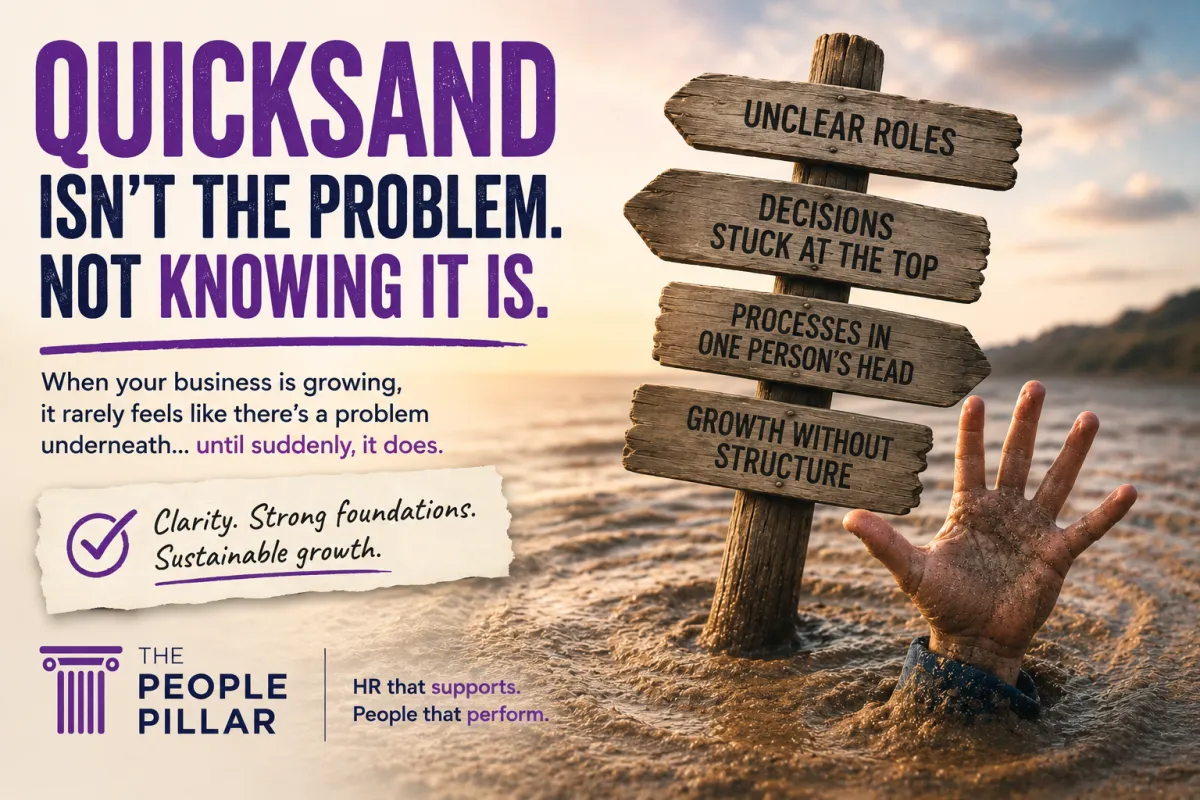
Is Your Business Built on Quicksand?
When I was little, thanks to films like The Neverending Story (still not okay don’t even get me started on Watership Down), I genuinely thought quicksand was going to be a much bigger problem in my adult life than it actually turned out to be.
I had strategies. I was ready.
Spoiler: I have never once encountered quicksand. Not even a little.
What I have encountered, over and over again, across nearly two decades of working with businesses at every stage of growth, is something that behaves remarkably like it. Not the dramatic, movie-style sinking. Not the bit where someone shouts “don’t struggle, it only makes it worse!” while you flail dramatically in the background.
The quieter version. The kind where things look absolutely fine on the surface until, quite suddenly, they aren’t.
The thing about quicksand is you don’t know you’re in it until you move.
That’s what makes it so insidious. When a business is growing, properly growing, with momentum and energy and the slightly chaotic joy of things actually working, it rarely feels like there’s a problem underneath. It feels like a slightly weird week. Then another one. Then someone leaves, or a project stalls, or a manager comes to you for the fifth time this month with something they really should have been able to handle themselves, and you find yourself wondering when everything got so… heavy.
The instinct at that point is to solve the immediate problem. Put out the fire. Have the conversation. Make the hire. Get through the quarter. And often, that works, at least for a bit.
But if the foundations aren’t solid, you’re not really solving anything. You’re just finding slightly firmer footing while the ground continues to shift beneath you.
What does it actually look like when a business is built on unstable ground?
It rarely announces itself. It tends to show up in patterns, things you probably recognise, even if you haven’t quite named them yet.
Roles that were never properly defined because things moved fast and people just got on with it. Which was great at the time. Less great now that three people think they own the same decision and nobody’s quite sure who does.
Processes that live entirely in one person’s head. Usually someone brilliant. Often someone who’s been there since the beginning. The kind of person you’d be genuinely lost without, and the fact that you’d be genuinely lost without them is precisely the problem.
Decisions that can only be made by one person. You, probably. The founder, the MD, the person who knows where everything is and why everything is the way it is. It works until it doesn’t, and then it really doesn’t.
A team that’s grown faster than the structures around them. Good people, doing their best, in roles that were designed for a much smaller version of the business, or were never really designed at all.
None of these things feel like emergencies when they’re happening. That’s exactly the point. They feel like normal. They feel like your normal, the particular texture of how things work at your company. It’s only when something shifts, a period of growth, a key person leaving, an unexpected challenge, that the instability underneath becomes visible.
Momentum is very good at hiding problems.
This is something I’ve seen more times than I can count. When a business is doing well, hitting targets, winning clients, growing the team, it generates a kind of forward energy that masks all sorts of friction. You can carry a lot of operational drag when things are going in the right direction. The extra hours, the workarounds, the decisions that loop back to you, the processes that only sort-of work, all of it gets absorbed into the general busyness of a business that’s moving.
It’s when things slow down, or scale up, that the drag becomes drag.
The company that couldn’t grow the team because no one was confident in how to hire and integrate new people properly. The manager who was brilliant at their technical job but had no idea how to lead people through change, and so didn’t, and things got messy. The founder who realised, mid-scale-up, that they were still involved in every significant people decision in the business, which had been fine at ten people and was now completely unsustainable at thirty.
Not dramatic. Not a crisis. Just… slow, compounding friction. The kind that costs you more than you realise, in time and stress and lost momentum, long before it becomes a real problem.
The fix is less complicated than you might think.
I want to be honest about this, because I think a lot of business owners assume that if there are gaps in their foundations it must mean months of work, expensive consultants, and a complete overhaul of everything. It almost never does.
What it actually takes, first and foremost, is clarity. Understanding what’s genuinely underneath, what is creating pressure, what is slowing things down, where risk is building quietly, what needs sorting first. Not a list of abstract things to fix, but a clear picture of your business: what’s working, what isn’t, and why.
That’s where we start with every client at People Pillar, before we do anything else. We look at what’s actually creating operational drag or founder overload, the roles, the processes, the decision-making, the people, and we come back with a clear view of what matters most and what needs addressing first. No unnecessary complexity. Just clarity on what’s underneath, so you can build on solid ground instead of hoping the quicksand holds.
Because here’s the thing: when you know what’s there, it stops being quicksand. It just becomes a problem you can solve.
And problems you can see? Much easier to deal with than the ones you can’t.
If you’re growing a business and something feels harder than it should — or you just have a nagging sense that you’re carrying more than you ought to be — it’s worth finding out what’s underneath before you build any higher.
Start at peoplepillar.co.uk, or book a conversation with us. No commitment, no hard sell, just a straightforward conversation about what’s going on in your business and whether we can help.

Happy Customers

Say hello

©2021 - 2024 People Pillar HR | Privacy Policy