
On demand HR Services
Blog
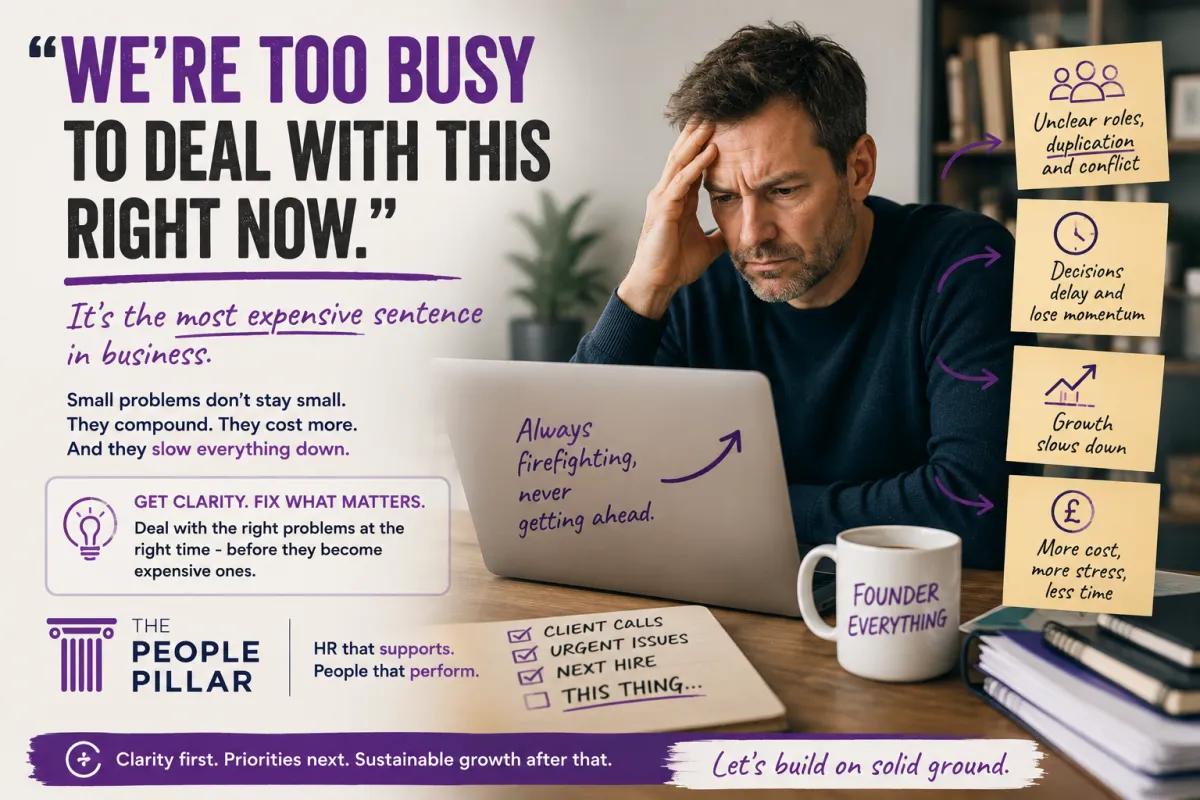
The Most Expensive Sentence in Business
“We’re too busy to deal with this right now.”
Sit with that for a moment.
Does it sound familiar? Even a little?
I’d be willing to bet it does. Because in all my years of working with founders and business owners, smart, capable, genuinely impressive people who are building real things, this is the sentence I hear more than any other. Sometimes out loud. Sometimes in the unspoken subtext of every meeting, every deferred conversation, every thing that gets bumped to next quarter and the quarter after that.
It is, without question, the most expensive sentence in business. Not because the problems it defers are always enormous. But because of what happens to them while you’re busy with everything else.
Here’s the pattern, and you’ll recognise it.
Something isn’t quite right. A team member who’s a bit off. A role that was never really defined properly. A process that relies too heavily on one person. A manager who keeps escalating things they should probably be handling themselves.
None of it is on fire. None of it is urgent in the way that your biggest client or your next hire or the product thing feels urgent. So it gets deprioritised. Reasonably, understandably, completely logically.
And then it starts to shape things.
The team member who was “a bit off” becomes a culture problem. The vague role becomes a source of ongoing conflict, two people pulling in different directions, neither entirely sure who owns what, both frustrated. The manager who keeps escalating things erodes your time so gradually that you don’t quite notice until you’re spending two days a week on things that shouldn’t need you at all. The skipped step that felt like a sensible shortcut at the time becomes, six months later, a significantly more expensive and time-consuming problem to unpick.
None of these stories have a dramatic moment. They’re compounding stories. The cost isn’t the big bang, it’s the slow accumulation of friction, time, energy, and money spent on problems that were entirely solvable when they were small.
This is what reactive mode actually costs you.
Not in dramatic terms. Not “this will destroy your business.” In compounding terms.
Every hour you spend on the thing that could have been handled at a lower level. Every good person who leaves because the environment was messier than it needed to be, and the replacement cost, financial and operational, that follows. Every decision that loops back to you because ownership was never made clear, meaning your time and mental bandwidth are being spent on problems that were never really yours to carry. Every piece of growth you couldn’t quite execute on, not because the market wasn’t there or the product wasn’t good, but because the people and operational side wasn’t in a state to support it.
Reactive mode is expensive. It’s just expensive in a way that’s easy to absorb, until you suddenly can’t absorb it anymore.
Here’s the counterintuitive part.
The founders who move fastest, the ones who scale well, who build teams that work without them in every conversation, who seem to grow without the grinding friction that quietly exhausts so many business owners, they aren’t the ones who had fewer problems.
They’re the ones who dealt with the right problems at the right time.
Not everything. Not a massive overhaul. Not months of consultants and restructuring. They just had clarity, at a point when there was still space to act on it, about what was actually creating pressure in the business, and they sorted the highest-impact things first while there was still room to do it without drama.
The difference between proactive and reactive isn’t discipline, or having more time, or being a different kind of founder. It’s timing. The same problem, addressed early, takes a fraction of the time and money it takes when you’re dealing with it under pressure. The same conversation, had before things deteriorate, is so much easier than the one you’re forced to have afterwards.
Being proactive doesn’t mean doing everything at once. It means knowing what to do and when to do it, rather than finding out what needed doing once it’s already become a crisis.
What it looks like to stop being reactive.
It’s not a transformation. It’s not a project. It’s not months of work before you see any benefit.
It starts with one thing: proper clarity on what is actually creating pressure in the business.
Not a list of everything that could be improved that list is infinite and largely useless. Not abstract concepts about best practice. A clear view of what, specifically, is creating friction, building risk, slowing things down, or keeping you involved in decisions that shouldn’t need you. And from that, a prioritised picture of what needs addressing first, what can wait, and what kind of support will make the biggest actual difference.
That’s it. That’s the starting point.
When you have that clarity, decisions become easier. You stop spending time on the wrong things. The team starts to operate with more confidence. Problems get addressed when they’re small and manageable rather than when they’re large and expensive. And you get some of your time and headspace back, which, if you’re anything like most of the founders I work with, is probably the most valuable thing of all.
At People Pillar, this is where we always begin. Before we do anything else, we make sure we understand what’s genuinely going on, the pressures, the risks, the things that are quietly draining capacity. It’s the kind of clarity that makes everything else faster, simpler, and more effective.
If “we’re too busy to deal with this right now” is a sentence you’ve said recently, or thought, even if you haven’t said it, it might be worth a conversation.
Visit peoplepillar.co.uk, or drop us a line to book a chat. Straightforward, no commitment, and very likely cheaper than the alternative.

Happy Customers

Say hello

©2021 - 2024 People Pillar HR | Privacy Policy